Sunday, November 10, 2013

Atlantic Crossing

Born in 1875, the Belgian painter Eugeen Van Mieghem grew up in the old port of Antwerp at his parents’ inn across Montevideostraat from the offices of the Red Star Line. A native of the docks, Van Mieghem would make them and their people his subjects. Millions of emigrants, the flotsam left behind by Europe’s crises, would board ships here – Jews from Poland and Russia escaping pogroms, Italians from the Mezzogiorno escaping starvation, disease, and violence at the hands of the brigante, and northern Europeans from Germany, France, and Belgium itself looking for land and opportunity. Van Mieghem would sketch and paint what he saw on the docks, beginning with the great migrations of the last decade of the nineteenth century and continuing into the troubled start of the twentieth, when he documented the desperate flight of the refugees of the Great War.

His people were humbled and tired, holding on to each other, waiting on the docks with their few possessions in straw baskets or tied up in blankets. In one painting, a boy, a ship to the New World at anchor behind him, plays an organetto. In another, a mother holds her baby, her older child clutches her skirt, while her husband, with his back to us, looks out over the harbor and into the future. Beside him, sitting, an elderly woman – the grandmother, perhaps – looks into herself. Van Mieghem painted the plight of these people in somber tones, or he drew them with charcoal, hurriedly, with quick strokes.

Olive grove in the fields below Castel San Vincenzo.
Photograph by the author.
One of Europe’s crises was happening far to Antwerp’s south. In 1891, Southern Italy was still suffering effects from the world depression, sometimes known as The Long Depression, which had begun with the Panic of 1873 in Vienna and spread throughout Western Europe and North America. Beginning in 1888, agriculture was especially hard hit with wheat prices dropping steeply. In the Mezzogiorno, the landowners had compensated by raising rents, the government by increasing local taxes. The contadini, those like Carmine and Cristina, though they might have owned a small patch of land themselves, still would have rented additional fields from the larger landowners. Each day, Carmine and Cristina would have taken a simple lunch, probably no more than bread and a little wine, and walked with other family and friends from San Vincenzo down the slope of Mont Vallone to their fields. The walk might have taken an hour or more. The return to the village in the evening would have been the same. Certainly, they would have grown vegetables in their fields. Perhaps, a field of wheat. The youngest daughter of Carmine and Cristina, Angeline, remembered the orchard. In the fall there would be grapes to harvest. In early winter there would be olives. The family would work their fields until the light was going. Stone huts, mortarless piles of rock stacked in concentric circles in the shape of a beehive, were scattered about the fields for shelter from storms. In many cases these had been in use by generations of ancestors, both in the fields and on the tratturi, the trails used during the year to drive sheep between the alpine valleys of the Apennines across the Rocchetta plain to the winter pastures in Foggia.

It was back-breaking work for all the contadini, and with rising rents and dropping prices, what had been a subsistence living was now no living all. In the evenings, perhaps in the bar over a glass of wine, maybe during La Passeggiata, the stroll about town when the people met, gossiped, and planned their futures, the talk had turned more and more to l’America. Men stood in groups in the piazza recounting how many of their relatives had already left, that there were jobs and money to be made in l’America. The police registry in Antwerp, which kept records of the emigrants who passed through there, had recorded many residents of San Vincenzo. Someone brought up the agent who had been recruiting in the area. By 1891, emigration had become an important business. Agents recruited, booked passages, arranged transportation to the ports. Perhaps, they could all go together. Those who had gone before were in Chicago. They wrote home. They sent money. A great world’s fair was being built there in what had been a muddy swamp. It was to be better than the last one in Paris. There was much work to be done. Who would go? Antonio Carracillo would go, and Antonio Di Silvestro, both fifty-eight. Young Donato Carracillo at eighteen years old would go, and Carmine and Cristina with their three children. Carmine’s first cousin Giovanni Di Julio would go with his wife Rosa Notardonato and their three chidlren. Another young man, Domenico Di Michele, nineteen, would go, as would Donato Colella and Beradino Di Cristofano.

Piazza Umberto today.
Photograph by the author.
Others would decide to go, as well. Some would back out. Then on a day in early April those still resolved gathered in the cool morning air with their belongings in what is now Piazza Umberto, San Vincenzo’s main square. The wives, the mothers who were staying behind, dressed in black in long sleeves and long, black skirts, hugged their husbands or their children. They kissed them. Their faces were distorted by grief and worry, and they hid them behind their hands as they wept. For the elderly, they could not know if they would ever see their loved ones again in this life. For some it was too much, the despair too great. A grandmother collapsed to sit on one of the baskets, her hands to her mouth as she was supported by a granddaughter. A young boy, standing apart from the crowd, screamed for his father, his sadness beyond consolation. A young wife wept to herself as she held her husband, who was leaving her to an unknown future.

A stagecoach at the Stelvio Pass in Northern Italy, 1881.
Public Domain.
Emiddio had just turned seven at the time. At the age of eighty, he would write that in his life he had “traveled by foot, by buggy and horse, by local trains, even by dinghy . . . by fast mail trains – by Southern two side wheels steamboats. By excursion boats [on] the lakes, by ships in the ocean.” According to nineteenth-century road maps of Italy, the roads in Molise were few. The nearest road to San Vincenzo appearing on these maps travelled through Alfedena, twenty kilometers to the north, which then connected up with a main road south to Isernia. From Isernia, another main road went by way of Venafro and Cassino and on through the Liri Valley to Frosinone. A railroad map from 1875 shows a rail line passing through there on its way to Rome. I can’t know exactly how they covered these distances. Probably, when they left San Vincenzo some were on foot, some in a wagon, perhaps, provided by friends or family and trailing behind a mule or a pair of donkeys laden down with the bundles and baskets. When they reached a road, they might then have connected with a diligenza, or stagecoach, the public conveyance of the time, which would have taken them on to Isernia and from there one-hundred kilometers further out of the mountains to Frosinone.

A valley on the way to Frosinone through which
the family would have travelled.
Photo taken by the author from Montecassino.
Once in Rome, another train would have taken them along Italy’s west coast to Genoa. From Genoa, they either went north to Lucerne or west to Nice. If they went north, once they traversed the Alps and arrived in Lucerne, they could have taken different paths to Antwerp – perhaps, to Dijon and on to Nancy, then through the deep, green forests of the Argonne and the Ardennes to Belgium. If they went west, they would have travelled across the foot of the Alps along the Mediterranean through Nice to Marseille. From there the line to Nancy would have taken them north through Provence to Avignon and then Grenoble and then across the wheat fields and vineyards of Champagne to Lorraine. Once in Antwerp, they would have found their way as all the emigrants in Antwerp did at this time to the Red Star Line warehouse in the oldest of Antwerp’s harbors, the Eilandje, on the Scheldt River.

Red Star Line ships alongside Rijn Quay, Antwerp.
Public Domain
Van Mieghem painted the scenes on Montevideostraat, where the emigrants gathered at the Red Star Line offices. He saw them cluttering the sidewalk, standing in groups, leaning on the red brick walls of the Red Star buildings, or sitting on their bundles. He painted the light muted here at this latitude on the North Sea. The emigrants occupied the entire length of the street, which still exists and still dead-ends on the Rijn Quay, where the ships were moored. From these sidewalks, from the cobblestones, the emigrants could see the masts of the ships and believe they had one foot in America. In 1893, the Red Star Line would create a dormitory in its warehouse to shelter the emigrants until their ships sailed, but in 1891, the emigrants stayed in crowded, airless guest houses around the quay. During good weather, they would stay outside as much as possible, even sleeping on the grassy Scheldt dike, as Van Mieghem captured. A medical exam would be conducted on the quay, no matter the weather. A doctor examined each passenger, looking for weakness or lameness, signs of mental illness, signs of infection. Any passenger rejected in New York by the American authorities would be returned at the Red Star Line’s expense. So, this was a careful inspection. There are records of family members failing this inspection and being left behind, cared for by one of the many agencies in Antwerp established to aid the emigrants. In some cases, they might wait for as long as five years before being released to join their families in America.

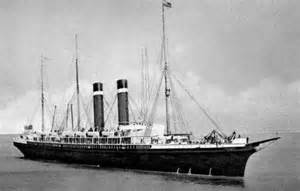
The SS Rhynland at sea.
From the collection of the author.
The SS Rhynland was built in England in 1879. Part sailing ship, part steamer, it was four hundred feet long and forty feet wide. On this crossing, it had eighteen saloon or first-class passengers, forty-one second-class, and seven hundred, forty-three steerage. The mass of those in steerage would be held behind barriers on the quay until the first- and then the second-class passengers had boarded. The emigrants would then be allowed to board, herded over the gangway on to the ship and directed down steep, almost perpendicular steps to “in-between” decks, as it was called, where a steward directed them to their compartments. They would be struck immediately by the smell of oil and tar, of the sawdust on the floor and the sour dampness of previous voyages. Simple wood partitions running the length of each side of the ship formed the compartments, each with a door identified by a letter of the alphabet – compartments “A” through “N” were forward, “O” through “Z” were aft. Within each compartment were two dozen or so berths in two tiers with their straw mattresses. If there were those who had made the voyage before, they would hurry to claim the upper berths. No one wanted to be in a lower berth beneath a fellow passenger who was seasick.

During the height of the emigration from Europe to America, numerous firsthand exposés were written by journalists posing as steerage passengers. In newspapers both in the United States and abroad, the details of life aboard ship were documented. The ships were often at capacity or near-capacity. As “in-between” decks filled up, the odors accumulated – the onions and garlic packed in the baggage, the salted fish, the cured meats and cheeses brought from home, all these smells mingled with those of the ship and of the unwashed passengers, who in some cases had not been out of their clothes since leaving home.

Carmine and Cristina along with their children were assigned to Compartment V in the aft of the ship. Also assigned to this compartment were Giovanni Di Julio’s wife and children. He, however, was assigned to Compartment B forward. It was not unusual to break up families between compartments. Single women could go into the compartments with families so space had to be made available for them. Single men were in the forward compartments. There were other families in Compartment V. Other Italians were there from regions foreign to the Molisani, also Hungarians, Germans, Austrians. The occupation of most of the single women was listed as “servant,” and there were several of these women in Compartment V – Mary Galinski, for instance, from Austria, and Julianna Ivan and Erszebeth Pörök from Hungary. Cristina would have difficulty with the sounds of these names and the sounds of the languages. Even Mattea Mattiotti, though from Italy, was not Molisani and her dialect was strange.

The Rhynland would cast off into the Scheldt on a day of a waxing moon. Tugs would accompany the ship through the bends of the narrow river. Finally, the river makes a last bend to the west into the broad Western Scheldt. The ship would keep the Dutch coast on its starboard side as it made its way to the mouth of the river and to the North Sea. Continuing west, the Rhynland would now follow the French coast through the English Channel. Perhaps, they came close enough to land to see the port of Calais. They also would have passed close to Cherbourg, which was perhaps the last sight of land for those who were on deck to see it.

Painting of the SS Rhynland under full sail by Antonio Jacobsen, 1890.
The open ocean would bring with it the routines of the crossing – the breakfasts of soup and bread, the dinners of stewed beef and potatoes, all served from kettles and eaten on the long wooden tables between the compartments in the twilight of “in-between” decks, in the light filtering through the portholes. In the beginning, there were not enough places at the tables. People would hurry to be at the front of the line to ensure getting a seat. Those who didn’t make it stood holding their plates and eating the best they could. Later, as seasickness affected more and more, there were always seats available.

There were periods of flat seas and warm afternoons when those from steerage would enjoy their time on the main deck. There they could take in the sunlight and watch the work of the sailors who climbed the shrouds to the yardarms to work the sails. They could find the shade from these sails if it was especially warm. They could play cards with others or sleep in the pure air or just daydream of their future. Often, some passengers would play their musical instruments, their tunes as varied as their languages. Sometimes there would be dancing, which all seemed to understand. Amidships, the second class and saloon cabins stood above the main deck. Off-limits to the emigrants, this area had its own decks for the promenades of the wealthy. The two groups would observe one another, but seldom was there contact, although there is one account in which a few saloon passengers gathered together and for amusement tried to guess the ethnicity of some of those in steerage. The single funnel, gold with a black cap and with a red star on each side, rose above all, trailing black smoke from the coal fires.

At times, the sea was heavy, the swells creating misery for those below decks, especially those who were all the way aft or forward. To the Molisani, seasickness was la miseria. Different cultures had their own remedies. Some tried apples or hard candy. Some had a patent medicine. Some believed in raw onions. Emiddio said that Cristina gave him white vinegar by the spoonsful and that they tried to stay amidships where the ship’s travel from wave crest to trough was less pronounced. The smell below became unbearable. Some would sleep on deck, but by policy the women were not allowed there after dark. The watchmen whose lot it was to enforce this policy sometimes had to chase the women from side to side of the ship before they could corner them. But for the men, they could lie on their backs and look up at the sky. April 24th, halfway through the voyage, the moon was full, its bright light glinting on the crests of waves, washing out the dimmer stars, its face the same here as it was in Germany or Russia or Hungary or high in the Apennines of Molise. I sometimes think of Emiddio lying there on the deck next to Carmine. Hands behind their heads, they contemplate this moon and, each in his own way, the future. For Carmine there must have been great excitement but also great fear. For Emiddio, the great city awaiting them offered adventure. The moon would not set this night until nearly dawn. In my mind, they lay here together, father and son, throughout the night, bathed in this moonlight, each with his own dreams.

In the early morning hours of May 1st, the passengers on deck would sense a change. As the ship sailed to the south of Long Island, though they could not see the land, they could smell it, or rather smell where the land meets the sea. The color of the water had changed subtly, now tinged with green. The emigrants leaned over the bulwarks at the front of the ship, leaning toward the horizon, leaning toward Sandy Hook, the narrow peninsula which forms an extension of the New Jersey coast into New York Bay. This was their first sight of land, their first sight of the New World. For the emigrants, Sandy Hook was the gateway to their new country. Geographically, this was true. But the “Golden Door” had not opened for them yet. It lay at the southern tip of Manhattan at the mouth of the Hudson River near the abandoned Castle Garden. It was known as the Barge Office.

Saturday, October 26, 2013

A Wedding


La Presentosa in silver from Abruzzo.
Photograph by the author.
The details of the wedding of my great-grandparents are no longer in living memory. No doubt, Emiddio would have heard stories through the years. Certainly, Cristina would have spoken of the event with her daughters. Perhaps, she showed them la presentosa. Maybe she pulled it from a drawer where she kept such keepsakes, unwrapping the tissue or handkerchief which enclosed it and displaying it for the girls in the palm of her hand, this most traditional of wedding gifts from the groom’s family, the gold or silver many-pointed star with the lovers’ hearts at its center.

A woman of Molise in
traditional wedding costume.
From Peasant Art in Italy
(1913) by Charles Holme.
Public domain.
She would have told them of being dressed by her matrons of honor – all would have been matrons, for unmarried women or girls weren’t allowed to attend. She would tell of how they first pulled over her head the white linen chemise, which was trimmed with lace from L’Aquila to the north, followed by the bodice, the comodino, worn like a vest, woven in black in the village of Pescocostanzo or in Scanno, embroidered with gold thread and trimmed with sky-blue ribbon. Next, the long sleeves, also embroidered in gold, joined to the comodino. The pleated wool skirt, the casacca, would then be wrapped around her by her matrons. It, too, would have gold embroidery and ribbon at its hem, which almost touched the floor. Over the skirt, the mantera would be added like an apron, folded over at the waist to display the intricate embroidery. Gold chains, a rosary, and finally la presentosa would go around her neck. After gold earrings, the headdress known as a tovaglia, made of red cloth, embroidered and with lace around its edges, would be placed on her head, folded and pinned to fall to her shoulders. Her matrons, dressed similarly to confuse evil spirits, would stand back and look at her. Never again in her life would Cristina enjoy such attention, such admiration.

Wildflowers in the Valle Fiorita.
Photograph by the author.
It was 1883 and May in the Apennines, a time of bright, crisp air, of trees leafing out, and of wildflowers in the valleys, especially in the high Valle Fiorita in the mountains above Pizzone, where there would still be late patches of snow, broken through by tufts of new grass and the occasional purple crocus. The melting snow fed icy streams, which crossed the valley floor, pooling in the low spots, the surface of the pools themselves white with wildflowers. Cristina would be the second of the daughters of Pasquale and Felicita to marry. Her older sister Francesca had married two years before and now had a son.

A street in Pizzone.
Photograph by the author.
It was a Sunday, domenica, the day which brings the best luck. The banns would have been read after Mass the Sunday two weeks before in the tiny piazza outside the door of San Nicola, as was the custom. Now, the day of the wedding, Cristina’s family would have gathered mid-afternoon at her parent’s house – all would be there, including grandparents and godparents, aunts and uncles and cousins. They would spill out into the narrow street and wait for the groom and his family to arrive from San Vincenzo. Carmine, his parents, Michele and Angelamaria, and other family members would join the growing crowd to begin the procession to the church.

A street in Pizzone.
Photograph by the author.
The wedding party would proceed through Pizzone’s streets, some little more than alleys that in winter months fill up with snow, most between the houses of neighbors, some of whom stood in their doorways or peered down from their balconies. Perhaps, a shower of wheat, of salt, even crumbs of bread might be tossed at the couple to represent abundance, fertility, and good luck. In the fields or working the orchard or tending the few sheep belonging to the family, Cristina would have worn sandals with over-long laces to wrap around and hold up the white cotton wrappings used to protect her ankles and lower legs from stubble and branches and to provide warmth. But today, she would have worn shoes, which during the procession would have felt awkward to her, slippery even when going up the steep hills on the cobblestones.

The campanile of San Nicola.
Photograph by the author.
They would round a final corner and see the campanile of San Nicola and then the front door of the church standing open. Perhaps, a blue ribbon and bow decorated the lintel, the church adorned with flowers from the valley. Carmine and Cristina would kneel before the priest and beneath the cool arches of San Nicola. They would kneel in the same spot where other couples before them had knelt together for over five-hundred years, and they would make their vows.

They would return to the home where Cristina was born and lived these last eighteen years. The family and close friends would go inside for dinner while others gathered outside. A lamb would have been roasted over coals. There also would have been cured meats, vegetable dishes, and pastas, as well as pastries and cakes. Food and drink would have been passed to those outside – frothy red wine and liquors flavored with sugar and herbs such as basil and fennel. Cristina would pass out to all those attending the sugared almonds known as bomboniere to take home with them. A musican playing a local bagpipe known as a zampogna and made in the neighboring village of Scapoli would dominate his fellow musicians on the organetto – similar to a concertina – maybe a tambourine, known as a tamburello, and the chitarra battente, or “beating” guitar, used for pounding out the rhythms. The spallata molisana, the tarantella, both dances descendents of the saltarello which went back to the Romans, would echo across the surrounding mountains as twilight set in. The spallata, which literally means “shove with the shoulder,” was among the most popular and was traditional at weddings here in Molise and in Abruzzo just to the north and in all of the areas once belonging to the Samnite people. The party would last until the sky lightened above the mountains as dawn approached. The guests gradually would wander home, arm in arm, to sleep.

In the coming days, Cristina and Carmine would join his parents on Via Centrale in San Vincenzo. Almost immediately, she would be pregnant with Emiddio. The coming year would be difficult. A catastrophic earthquake centered in the Gulf of Naples would cause great damage across southern Italy. And then in 1884, a cholera epidemic in the months after Emiddio’s birth would claim the lives of thousands. Carmine and Cristina now owned a little land. Two other children followed: another son, Vincenzo, in 1886, and a daughter, Maria Assunta, in 1887. For now, Fortuna was kind. At least, they were getting by. But soon they would take a chance, convinced that a better future awaited them. The lure of l’America was becoming irresistible for many Molisani and for Italians in general. Soon, Cristina and Carmine would follow others from their villages and travel first to France and then to the great port of Antwerp. A ship of the Red Star Line, the SS Rhynland, awaited them there.

* * * 

Below are videos of the dances and music referred to above.


Saturday, October 12, 2013

San Vincenzo al Volturno, 1857

The narrow road from Pizzone to Castel San Vincenzo travels four kilometers across the valley floor up onto a rocky ridge along the lower slopes of Monte Vallone. Prior to 1928, Castel San Vincenzo had been two villages: the first, along the top of the ridge and built on ancient fortifications, was Castellone – or Castellum, as it was recorded in the medieval Chronicon Vulturnense – the second, a little lower down, was San Vincenzo al Volturno.

Castel San Vincenzo with the Mainarde behind.
Photograph by the author.
During Roman times, these lands were known as Samnium, named for the Sanniti, or Samnites, the fierce Italic tribe who had inhabited the region for centuries and with whom the Romans fought three wars. In place names such as Civitanova del Sannio or Mirabello Sannitico, and in archaeological ruins such as the temple and theater unearthed in Pietrabbondante or the cyclopean wall at Colli a Volturno, and in the passion of the people for their history, the presence of the Sanniti is felt here still.

Beneath the heights of Castel San Vincenzo is the Rocchetta plain, which from the age of Augustus had been the site of villas and agricultural estates, some likely connected to prominent families from nearby Isernia, a provincial capital then as it is now. According to the Chronicon, the emperor Constantine was travelling through the Apennines and stopped here in a densely wooded area to rest in the cool shade. After eating a large meal, he fell asleep and had a vision of three saints who told him to build an oratory here in this place of wild beasts and solitude. Constantine’s oratory, forgotten in this wilderness, would be discovered three centuries later by three noblemen from Benevento to the south. Paldo, Tato, and Taso, as they were known, would choose this place as the site of their abbey, which they would dedicate to Saint Vincent, the Spanish deacon martyred during the time of Constantine’s grandfather, during the last and the bloodiest of the persecutions of Christians, which occurred during the reign of the emperor Diocletian.

The Rocchetta plain seen from Castel San Vincenzo.
Photograph by the author.
The abbey, near the source of the Volturno River, would become known as San Vincenzo al Volturno. With Paldo as its first abbot and with generous land grants from the Beneventan nobility, it would gain great prominence in the years to come, becoming a rival to the great sixth-century abbey at nearby Monte Cassino, even hosting first Aistulf and then Desiderius, the Lombard kings whose tribe had first come to this region two hundred years before. In 773, Charlemagne began his campaign against Desiderius. The victory of the Carolingians, however, did not upset the social order established by the Lombards. Instead, they supported it, bringing about a technical and cultural renaissance. The Church was an important part of this, and as a result San Vincenzo became a center of learning and political power in the medieval world.

Abbot Epyphanius from the fresco
in the Crypt of Epyphanius. The square
halo indicates he was alive at the time
this was painted.
Photograph by the author.
By 824, when Abbot Epyphanius took office, San Vincenzo was at its zenith. Abbot Epyphanius would finish the great works begun by his predecessors, completing the monastic city with the basilica San Vincenzo Maggiore at its heart. But difficult years were ahead. After surviving a violent earthquake in 847, San Vincenzo would be raided and burned in 881 by an Arab-Berber band. The monks defended the abbey. Hundreds were killed, according to the Chronicon, before they were overwhelmed, the survivors fleeing to Capua. It would be thirty-five years before they would return and start to rebuild.

By the end of the tenth century, much of the abbey, including San Vincenzo Maggiore, remained in ruins. The abbey had lost much of its lands, leasing them to settlers. The Chronicon records a twenty-nine year lease given in 945 by Abbot Leo to four men: Lupus, son of Teudosus; Petrus, son of Yselbertus; Adelbertus, son of Flora; and Adus, son of Leopardus. This was the charter for Castro Samnie, the Samnite past recognized in the naming of this village that would become Castel San Vincenzo. In the next century, a new abbey would be built across the Volturno, across the hump-backed Roman bridge, which still exists, known as the Ponte della Zingara or Bridge of the Gypsy. The ruins of the old abbey would serve for building materials.

The Virgin Mary as Queen in the
Crypt of Epyphanius.
Photograph by the author.
Over the next eight hundred years, the old site would be covered over, its exact location lost. It was not until March 10, 1832, that the Crypt of Epyphanius was found accidentally beneath a barn belonging to Domenico Notardonato, who immediately notified his priest. Viewing the crypt through a small rectangular window, the priest could see that it was partially filled with earth, but in the gloom a glimpse of the muted colors of the frescoes which covered the walls could be seen. It would be the end of the century before this crypt was entered and the beauty of the Byzantine frescoes revealed.

It was into this world, on July 17, 1857, on Via Centrale, past the twelfth-century gate known as the Portale San Filippo, that my great-grandfather, Carmine Di Julio, father of Emiddio, was born to Michele Di Julio and his wife Angela Maria Concetta Vacca. In four years, the world for little Carmine would change. As the decade of the Italian unification, or Risorgimento, began, the ancient feudal past of his father began to come unwound. There would be new challenges to these people of the Terra di Lavoro to whom nationalization would feel more like conquest and colonization by the North. Besides hunger and the loss of land, there would be the brigante, the bandits with little to lose who would roam these hills in the years to come, occupying Castellone and San Vincenzo twice in 1861 alone. 

Portale San Filippo, Castel San Vincenzo.
Photograph by the author.
On the rounded ceiling of the Crypt of Epyphanius, inside the small window as far as could be reached, graffiti was found. I think of my great-grandfather. I imagine the adolescent, who, perhaps, came to this place with other village boys – or, perhaps, on a dare, in the dead of night, by himself to make his mark. I try to see what he would have seen, to hear what he would have heard, to smell the odors carried on the night air. In this way, I hope to close the gap, to erase the distance of the years back to this man I never knew but whose essence is in my bloodstream. In a few years, Carmine would marry the young girl across the valley in Pizzone. Together they would start a new life on Via Centrale. Like other young people in the village, they would want better – for themselves and for their children. They would save what money they could. They would plan with the others, and together they would book their passage. There was courage in numbers. And together they would cross the Atlantic to the New World.

Saturday, September 28, 2013

Pizzone, 1865

Pizzone, photo courtesy of Alfonso Notardonato
Maria Cristina Di Benedetto, my great-grandmother and the mother of Emiddio, was born April 4, 1865, in Pizzone, a tenth-century village surrounded by the Mainarde and Meta mountains in Molise, the small, mountainous region of Italy about one-hundred miles southeast of Rome.

Her birth was registered in the Stato Civile office in Pizzone, which recorded that she was presented by her father, Pasquale, and that her paternal grandmother, Francesca Di Vito, was the witness. The Sindaco, the mayor at the time, then signed the document. More than ten years before, from 1854 to 1856, Cristina’s father had been Sindaco. During his first year as mayor, his son Antonio was born. On the Atto di Nascita, the civil Act of Birth, Pasquale is listed as un proprietario, a land owner. However, by the time Cristina was born, some misfortune had reduced his circumstances. He was now un contadino, a farmer who rented land, a peasant. The unification of Italy, which began in 1861, resulted in difficult economic times in southern Italy. This might have been the cause of Pasquale’s reversal. Many southern Italians lost their land during this time.

And there were other troubles. The child Antonio would not survive. Pasquale and his wife Felicita Di Iorio (Italian women did not take the surname of their husbands) lost their first three children. Infant mortality was high in this part of Italy during the second half of the nineteenth century. It was common for women of this time to bear children every other year or so for twenty years. To lose three children was not unusual. The unfortunate infant would often be laid out in his or her christening gown. The tiny coffin would be carried on a draped board or tabletop during the procession to the cemetery, the pallbearers at each corner. Sometimes, the coffin was carried just by the mother, balanced on her head.

The campanile of San Nicola
Perhaps, because of this frequency of death, it was customary that infants were baptized quickly. Cristina was baptized the day after her birth in the Church of San Nicola. Built in the year 1318, San Nicola had been La Madre Chiesa for the Pizzonesi for more than five centuries. The pages of the baptismal record of San Nicola for 1865 still had the seal of Terra di Lavoro, the old province name from before unification when Pizzone was a part of the Regno delle Due Sicilie, the Kingdom of the Two Sicilies. Terra di Lavoro, Land of Work, is an apt description of this rugged country in which Cristina would grow up. But for now, being held before Archbishop Santucci of San Nicola in the arms of her father, her mother at his side, and her mother’s younger sister Angelamaria with her husband Giovanni Di Vito there as Cristina’s padrini, her godparents, that was all still ahead of her.

Monday, September 16, 2013

Going Home

At 9:00 o’clock on the morning of June 14, 1902, after an Atlantic crossing of six and a half days, my grandfather Emiddio Tobia Di Julio arrived in New York harbor. Eighteen years old and with ten dollars and change in his pocket and a ticket for the train, he was on his way to Chicago. His ship had sailed from Southampton, but probably Emiddio embarked at Cherbourg, since he had been living in France and Cherbourg was a common port of call for west-bound liners. “Going home,” he had said in English to the ship’s chief officer who interviewed him, and this was duly recorded on the ship’s manifest. Upon arrival in New York, an Ellis Island official added the notation “99 E. Indiana St.” as Emiddio’s destination in Chicago, an address in an area of the city nicknamed “Little Sicily,” or sometimes “Little Hell.”

SS Philadelphia
The SS Philadelphia prior to World War I.
The ship that had carried Emiddio to the New World was younger than he. Launched in 1888 as the SS City of Paris four years after Emiddio’s birth in 1884, it would serve as a liner for first the Inman and then the American Lines. In 1898 it was armed and commissioned as the U.S. Navy cruiser USS Yale, and it was under this name that it served in Cuban waters during the Spanish-American War. The following year, the ship was disarmed and returned to commercial service as the SS Philadelphia. It was as the Philadelphia during the week of February 22, 1902, that the ship played a historic role in satisfying the skeptics that the wireless telegraph of the young inventor Guglielmo Marconi was indeed capable of transmitting and receiving messages across the Atlantic.

The SS Philadelphia with Marconi's radio masts.
Verified by Captain A.R. Mills of the Philadelphia and Chief Officer C. Marsden, several messages were received and transmitted between the ship and Marconi’s station at Poldhu, Cornwall, England, including one from the morning of February 25th which was endorsed by Officer Marsden: “Received on SS Philadelphia lat 45.15 N. Long 38.05 W from Poldhu (Cornwall) over a distance of 1,551.5 (one thousand five hundred and fifty-one and a half) statue miles. C. Marsden, Chief Officer.”
The confirmation by Officer Marsden that the transmission of February 25, 1902, had been received.
The New York Times covered Marconi’s arrival in New York. Referring to the young Marconi, a native of Bologna, as “William,” they reported on his achievement on March 2nd with the headlines, “MARCONI’S TRIUMPH IN MID-OCEAN,” “2,000 Miles from Cornwall He Receives a Signal,” and “Full Messages, Plain, and Attested by the Philadelphia’s Chief Officers, Received Over 1,500 Miles from Poldhu Station.”

Four months later, after Marconi had startled the crew of the Philadelphia and the world, Officer Marsden would interview Emiddio. Marsden dutifully asked the questions on the form: He asked whether Emiddio had ever been in prison or an almshouse or supported by charity. He asked if he were a polygamist. He evaluated his physical and mental health. Satisfied, Marsden then signed the affidavit at the bottom of page “G” of the ship’s manifest:
I, C. Marsden, Chief Officer of the “Philadelphia” from Southampton, do solemnly, sincerely, and truly swear that I have made a personal examination of each and all of the passengers, 30 in number, named on the foregoing List or Manifest, and that I have caused the Surgeon of said vessel, sailing therewith, or the Surgeon employed by the Owners thereof, to make a physical examination of each of said passengers, and that from my personal inspection and the report of said Surgeon, I believe that no one of said passengers is an idiot or insane person, or a pauper, or likely to become a public charge, or suffering from a loathsome or dangerous contagious disease, or a person who has been convicted of a felony or other infamous crime or misdemeanor involving moral turpitude, or a polygamist, or under a contract or agreement, express or implied, to perform labor in the United States, except such as are expressly excepted under the law. And that also, according to the best of my knowledge and belief, the information in said list or manifest, concerning each of said passengers named thereon, is correct and true.
Detail from the ship manifest of the affidavit signed by Officer Marsden.

La Fontaine Bartholdi in Lyon
This was Emiddio’s second west-bound Atlantic crossing. The Statue of Liberty welcomed him to L’America a second time. The skin of Bartholdi's great colossus was a dull copper the last time Emiddio had seen it, but now a green patina had begun to spread that would cover it completely in a few years. Perhaps, after living in France, Emiddio knew its French name: La Liberté éclairant le monde, Liberty Enlightening the World. Perhaps, he had even visited Lyon, not a great distance from his village and there had been family there, and seen another of Bartholdi’s sculptures, the magnificent fountain in the Place des Terreaux – Marianne, the allegorical figure of France, riding a chariot pulled by four barely controlled horses, the four great rivers of France: the Seine, the Loire, the Rhône, and the Garonne.

Perhaps, upon entering New York harbor, Emiddio thought of France, which he had just left behind, of Provence, where he had been living. Years later, he would publish a book of poems in Avignon, poems which celebrate Provence. “The Serenade of Our Village Near Avignon” (“La sérénade de notre village près d’Avignon”) begins
O brillant ciel étoilé de notre village !
Animé par le beau clair de la lune.
La sérénade d’amour est de notre propre langage,
Le chant est pour la rouge, la blonde ou brune.
“Oh, shining starry sky of our village, charged by the beautiful light of the moon. The serenade of love is our own language. The song is for the red-haired, the blonde or brunette . . .” Emiddio was sixty-eight when this poem was published. But this was the poem of a young man. Or of an old man recounting the emotion of his youth. It was this young man who would pass through Ellis Island and board the train for Chicago. No doubt, on his long journey across the American heartland, he would think of the family he left behind, the redheads, the blondes, the brunettes, but also he would consider this new America, which he would now face alone.